You can have a technically sound website, publish useful content and still watch your pages sit stubbornly on page two of Google.
Often, the problem is closer to home.
Your page may not be making its topic, purpose or relevance clear enough. The title might be vague. The content may target the wrong search intent. Important pages might be buried three clicks deep. Or the copy may contain all the “right” keywords without actually answering what the searcher came looking for.
That is where on page SEO comes into play.
Key Takeaways
- Start with the search, not the keyword. Understand what people in the UK actually want when they make a particular search, then build the page around that intent.
- Get the page fundamentals right. Titles, headings, URLs, content, internal links, images and metadata all contribute to how clearly a page communicates its subject.
- Make the page genuinely useful. Strong on-page SEO also means readable content, sensible navigation, mobile usability and good Core Web Vitals.
- Keep improving what already exists. Search Console data can show where pages are getting impressions but missing clicks, or attracting visitors without generating meaningful business results.
What Is On-Page SEO?
So, what is on-page SEO, exactly?
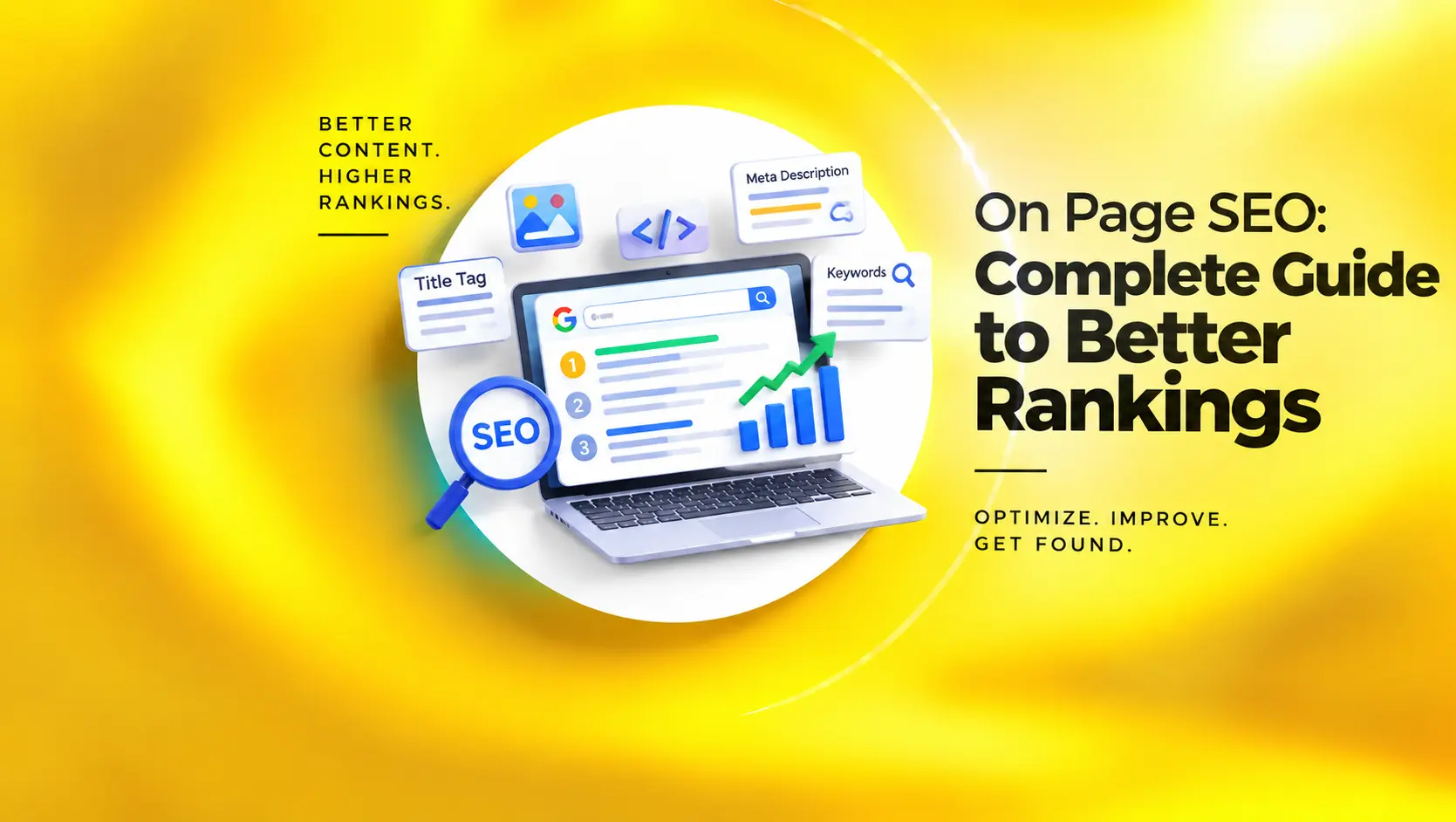
It is the work you do on an individual webpage to help search engines understand its content and help visitors find what they need.
That includes the obvious things, such as your copy, title tag and headings. It also covers less visible elements such as internal links, image alt text, URL structure, structured data and aspects of technical page experience.
Semrush groups areas such as content, title tags, headings, URLs, internal linking and image optimisation within on-page SEO.
The important bit is that these elements shouldn’t be treated as isolated boxes on an SEO checklist.
Take a UK business selling accounting software.
A page targeting “accounting software for small businesses UK” needs more than those words scattered across the page. It should address the needs of that audience, explain relevant features, reflect the UK market and give visitors a clear next step.
That is what good on-page optimisation looks like in practice.
- Get the Search Intent Right Before Touching the Copy
This is where many optimisation jobs go slightly off the rails.
A keyword gets added to a content brief, a writer produces 1,500 words around it, a few headings are created, and the page goes live.
But what does the searcher actually want?
Consider the difference between “What is local SEO?” and “Local SEO agency London” They are both SEO-related searches, but they represent completely different situations.
The first person is looking for information. The second could be comparing agencies, checking services or preparing to make an enquiry.
The page should reflect that difference.
Before writing or rewriting a page, look at the search results themselves. Is Google showing guides, service pages, category pages, product pages or local businesses? What topics keep appearing? Are there featured snippets or People Also Ask questions? What information do the pages ranking well tend to cover?
The SERP gives you a useful clue about what Google believes satisfies the query.
From there, decide what the page needs to do. For an informational query, that could mean explaining a concept clearly and thoroughly. For a commercial query, visitors may need pricing information, services, case studies, expertise and evidence before they are ready to enquire.
Google’s own guidance puts the emphasis on helpful, reliable, people-first content rather than pages created primarily to manipulate search rankings.
That distinction matters. Write for the reason behind the search, not just the words in it.
- Give Google Clear Signals About What the Page Is About
Once the intent is sorted, look at the page itself. Your title needs to earn the click The title tag is one of the first things a searcher sees in the results.
Compare “SEO Services | Xparro” with “SEO Services for UK Businesses | Xparro”. The second gives considerably more context. It tells the searcher what the page offers and who it is aimed at.
Google recommends titles that are descriptive, concise and unique rather than vague or repetitive.
Don’t try to cram every variation of a keyword into the title. One clear, relevant title is usually far more useful than something that reads like a keyword list.
Use headings to organise the page
Your H1 should make the main subject obvious. Then use H2s and H3s to break the subject into sensible sections.
For example:
- H1: SEO Services for UK Businesses
- H2: What Our SEO Services Include
- H2: Our SEO Process
- H3: Technical SEO
- H3: Content Optimisation
- H3: Digital PR and Link Building
This isn’t about hitting a magical heading formula. It is about making the page easy to understand. Someone should be able to skim your headings and know roughly what the page covers.
Put keywords where they make sense
Your primary keyword should appear naturally in important areas such as the title, H1, introduction and relevant headings.
But don’t turn the copy into SEO services UK businesses need from an SEO services UK agency providing SEO services in the UK… Search engines don’t need that.
Google recommends using the words people would search for in prominent locations, while its broader guidance stresses useful content written for people.
Use related terminology naturally. If you’re writing about technical SEO, terms such as crawling, indexing, canonicalisation, JavaScript rendering, XML sitemaps and robots.txt may belong on the page because they are genuinely relevant to the subject.
That’s topical relevance, not keyword stuffing.
Keep URLs boring
Boring is good here.
/seo-services-uk/ is easier to understand than /services/digital-solutions/seo-service-page-2/
A clean URL tells users and search engines what they’re looking at without making them decode it.
- Improve the Page Beyond the Words
Great copy won’t rescue a frustrating webpage. There are several other pieces of the on-page puzzle worth checking.
Internal links should have a purpose
Internal linking is often treated as an afterthought: publish a blog, add three links, move on. Instead, think about how your pages relate to each other.
A blog explaining “what is technical SEO?” could naturally link to a technical SEO service page. A page about local SEO could point readers towards relevant local SEO services or a guide to Google Business Profile optimisation. The link should make sense to someone reading the page.
Google also recommends descriptive link text because it helps users and search engines understand the destination.
“Read more” tells the reader very little. “Explore our technical SEO services” tells them exactly what they are clicking.
Don’t forget images
Images can make a page easier to understand, but they can also become dead weight if they are unnecessarily large.
Use appropriately sized images, modern formats where practical and descriptive alt text when the image conveys useful information.
Alt text isn’t a secret place to hide five keywords.
If the image shows an SEO specialist analysing a Search Console report, something like “SEO specialist reviewing Google Search Console performance data” is considerably more useful than “best SEO services UK SEO agency SEO”.
Watch Core Web Vitals
Page experience has measurable technical components.
Google’s Core Web Vitals currently focus on:
- LCP: 2.5 seconds or less
- INP: 200 milliseconds or less
- CLS: 0.1 or less
These are assessed at the 75th percentile across mobile and desktop experiences.
In plain English, users shouldn’t have to stare at a blank screen waiting for the main content, wonder why a button isn’t responding or watch the page jump around while it loads. A technically healthy page gives your content a better environment to do its job.
- Don’t Treat On-Page SEO as a One-Time Job
Here’s the part that gets overlooked. You publish a page, it gets indexed, you check the ranking once or twice, then everyone moves on.
Meanwhile, the search results change. Competitors improve their pages. Your business launches new services. Search behaviour shifts. Your page might start appearing for queries you never originally targeted. That data is useful.
Google Search Console can show which queries are generating impressions and clicks, along with metrics such as CTR and average position.
Suppose a service page gets 20,000 impressions but only 300 clicks. That doesn’t automatically mean the page needs more content.
The title and search snippet might need work.
Now imagine another page is sitting around positions 8–15 for several closely related commercial queries. That could be a much more interesting optimisation opportunity. Perhaps the page needs better intent alignment, stronger internal links, clearer topical coverage or a more useful structure.
Look at the evidence before changing the page, and don’t judge success by rankings alone.
For a commercial website, the useful questions are bigger:
- Is the page attracting the right people?
- Are visitors moving towards an enquiry or purchase?
- Is organic traffic contributing to revenue?
A page ranking highly for an irrelevant informational query isn’t necessarily doing much for the business.
SEO should eventually connect to something beyond a position number.
An On-Page SEO Checklist Worth Actually Using
Before publishing or refreshing a page, check:
Does the page satisfy the search intent?
Is the primary keyword naturally present in important locations?
Is the title specific and unique?
Does the H1 clearly describe the page?
Are the H2s and H3s logically organised?
Is the URL short and descriptive?
Does the content answer the questions users actually have?
Are internal links relevant and descriptive?
Are images properly sized and given useful alt text?
Does the page work properly on mobile?
Are Core Web Vitals within Google’s recommended thresholds?
Is structured data relevant and correctly implemented?
Are Search Console and analytics being used to assess performance?
Structured data can also help Google understand certain types of content and can make eligible pages suitable for enhanced search appearances.
Final Thoughts
Good on-page SEO is less about finding a secret ranking trick and more about removing confusion.
The searcher should understand what the page offers. Google should understand what the page is about. The structure should make sense. Important pages should connect to one another. And the experience shouldn’t get in the user’s way.
That sounds straightforward.
Doing it properly across an entire website is where the real work begins.
For UK businesses competing for valuable search terms, that work can mean the difference between having content that merely exists and having pages that attract the right searches, earn clicks and support real business goals.
Need help turning your website into a stronger organic search channel? Xparro can help. From technical on-page improvements and content optimisation to internal linking and search intent mapping, our SEO approach is built around making every page work harder for your business.
Explore Xparro’s SEO services and start building a website that is easier to find, easier to understand and easier to convert.
FAQs
- What is on-page SEO?
It’s the process of improving the things on your website that you can control, from content and headings to links, images and page structure.
- What are some effective on-page SEO techniques?
Start with search intent, then work on your titles, headings, keywords, internal links, content quality, images and page speed. The goal is to make the page genuinely useful, not just keyword-heavy.
- How often should I update my on-page SEO?
There’s no magic schedule. Keep an eye on your rankings, traffic and Search Console data, and refresh pages when performance drops or the search intent changes.