You’re Getting Traffic. But Why Aren’t You Getting Customers? Thousands of visitors hit your website each month. They click. They read. They vanish. No demo requests. No lead generation. No sales.
Does this story ring a bell?
This is not an issue of traffic. It’s a question of approach.
Instead of focusing on creating strategic blog posts, using trending keywords, and counting vanity metrics, other companies are building an inbound system of attracting, nurturing, and converting highly qualified buyers 24/7.
Great businesses do not “force” themselves to sell more. They become solutions that their prospects seek.
That’s what inbound marketing strategy does for you.
Here, in this ebook, we will look into proven frameworks, techniques, content creation approaches, workflow automation and conversion processes that bring revenue to American businesses.
What Is Inbound Marketing?
Before diving into strategies, let’s start with understanding inbound marketing.
Inbound marketing is a customer-focused approach to attracting potential buyers with valuable content and experiences that suit their interests rather than interrupting them with advertisements.
As opposed to pursuing clients…
Clients find you.
Just think about how you search for products yourself.
When you are ready to purchase some software, contract some agency, or get expensive equipment – what do you do?
You use Google. You make comparisons. You watch videos. You write queries to ChatGPT. That’s inbound marketing in practice.
Your company appears precisely at the moment when prospects are searching for answers.
Inbound Marketing vs Digital Marketing: What’s the Difference?
Many businesses use these terms interchangeably.
They’re not the same.
| Inbound Marketing | Digital Marketing |
| Strategy-focused | Channel-focused |
| Pulls customers toward your brand | Can both attract and interrupt users |
| Focuses on long-term authority | Includes both short and long-term campaigns |
| Relies heavily on valuable content | Includes PPC, display ads, email, SEO, social media |
| Builds trust first | May prioritize immediate conversions |
Think of it this way. The digital marketing is the toolkit. The inbound marketing is the map.
The SEO, email marketing, automation, webinars, content marketing, podcasts and social media are all channels for the digital marketing.
But when they are used to educate, nurture and convert prospects organically, they are inbound marketing.
And that’s the actual distinction between inbound marketing vs digital marketing.
Why Inbound Marketing Works Better Than Ever in 2026
The buying process has undergone a complete transformation.
Now, the customer completes about 70% of the purchase research before even contacting the sales representative.
Which implies that your website becomes the most important sales representative you have.
The customer expects:
- Educational resources
- Transparency of pricing
- Case studies
- Comparisons
- Interactive tools
- Reviews
- Video presentations
If they are not available at your website, they will be available somewhere else. Because inbound marketing fits into the needs of modern consumers perfectly.
The Four Stages of Modern Inbound Marketing
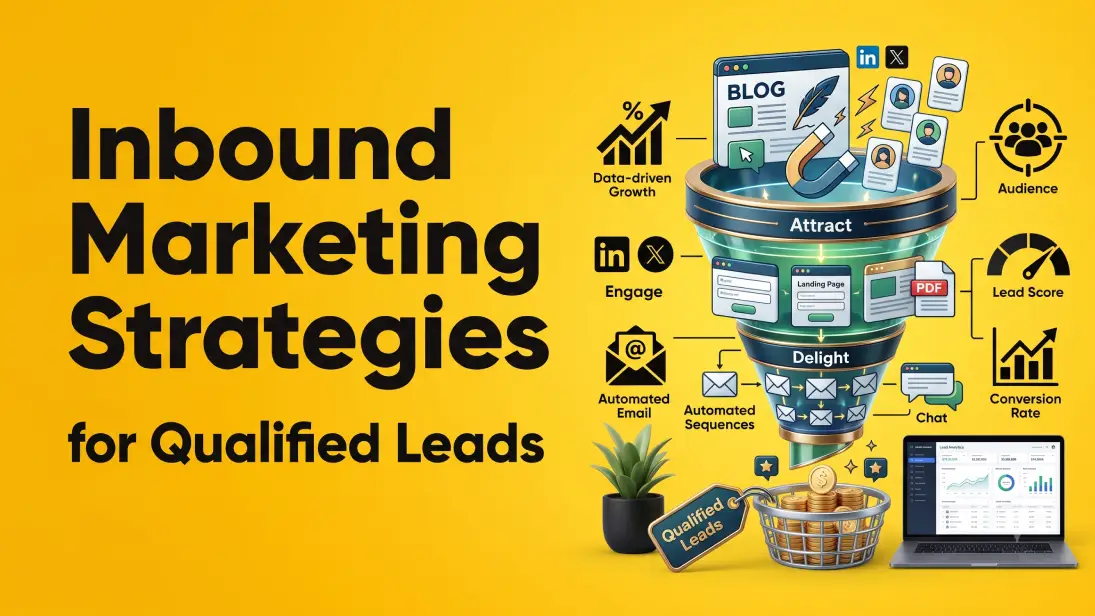
Every successful inbound strategy follows four stages.
1. Attract
Attract qualified visitors by using:
- SEO
- AI-driven search optimization
- Educational blogs
- Thought leadership on LinkedIn
- YouTube videos
- Podcasts
- Social media
Objective is to attract relevant visitors and not random ones.
2. Engage
When visitors arrive, engage with them.
For example:
- Interactive calculators
- Industry reports
- Free templates
- Webinars
- Comparison pages
- Case studies
Objective:
To build trust.
3. Convert
Traffic is worthless without conversion.
Visitors must be led towards:
- Demo requests
- Consultations
- Newsletters
- Product trials
- Contact form submissions
Conversion optimization is just as important as SEO.
4. Delight
Conversion does not equal the end of the customer journey.
Happy customers will turn into:
- Brand advocates
- Referrals
- Repeat customers
Delighting the customers involves:
- Personalized onboarding
- Educational newsletters
- Customer community
- Product education
- Exclusive content
Happy customers result in organic growth.
12 Proven Inbound Marketing Strategies That Drive Revenue
Let’s move beyond theory. Here are some proven inbound marketing strategies.
1. Build Topic Clusters Instead of Random Blogs
Google doesn’t give points anymore for standalone articles.
Now it gives for topical authority.
Instead of creating:
- SEO definition
- SEO tips
- SEO checklist
Create a topic cluster.
Example:
- Pillar page
- Comprehensive guide on SEO
Supporting content:
- Technical SEO
- Local SEO
- eCommerce SEO
- Link building
- Core Web Vitals
- AI SEO
Everything is interconnected. Search engines recognize your authority. Users will spend more time there. Authority grows.
2. Map Content to Buyer Intent
Every user that comes to your site isn’t ready to purchase right now.
And different users need different content at different stages.
- Awareness
- Education blog posts
- Industry statistics
- Guide posts
- Consideration
- Comparison articles
- List of the best software tools
- Strategy posts
- Decision
- Pricing
- Testimonials
- Case studies
- Product demos
This simple connection can increase conversion rate.
3. Create High-Intent Landing Pages
Your visitors aren’t supposed to land on your homepage.
Instead make pages with targeted content for:
- Industry
- Service
- Geographic area
- Specific customer pain point
Example:
Instead of:
“Marketing services”
Use:
“SEO services for SaaS companies”
The more relevant your landing page is, the higher the conversion rate.
4. Use AI Search Optimization
Search is changing rapidly. People now pose complex questions to AI assistants.
Optimize for conversational searches such as:
- Best CRM for startup businesses in healthcare
- What should I do to lower my CAC?
- Best SEO agency for manufacturing industries
By incorporating the following elements:
- Answers
- Structured headers
- FAQs
- Entity optimization
- Schema markup
Your content is optimized for AI.
5. Turn Every Blog into Multiple Content Assets
One blog post shouldn’t be ‘just one blog post.’
Turn it into:
- LinkedIn post
- Infographic
- Newsletter
- YouTube Short
- Podcast
- Webinar
- Carousel
One idea. Ten distribution platforms. That is what smart inbound marketing is.
6. Build Automated Email Nurture Sequences
Most visitors won’t buy immediately. That’s normal. Automation keeps the conversation alive.
Example:
Day 1 – Welcome email
Day 3 – Educational guide
Day 6 – Case study
Day 10 – Product comparison
Day 14 – Demo invitation
Instead of aggressive selling, you’re building confidence.
7. Publish Original Research
Everyone cites statistics. Very few make their own.
- Do surveys.
- Analyze customer data.
- Publish annual reports.
- Benchmark your industry.
Data will naturally generate backlinks, citations, and media coverage. Your authority compounds exponentially.
8. Optimize Every Conversion Path
Leakage is inevitable everywhere.
Optimize:
- Call-to-action placement
- Page speed
- Mobile responsiveness
- Form length
- Button wording
- Visual hierarchy
Even small optimizations will raise conversion rates by double-digit percentages.
9. Use Interactive Content
People love to engage.
Create:
- ROI calculators
- Website grader tool
- Cost calculator
- SEO audit tools
- Quizzes
- Assessments
Interactive content boosts engagement and leads generated by the roof.
10. Focus on Video SEO
Videos exist all over Google Search, AI Overviews, and YouTube.
Produce:
- Product tours
- Tutorials
- Interviews with customers
- Webinars
- Industry explainers
Embed videos in blog posts for maximum engagement.
11. Personalize Website Experiences
Modern inbound marketing relies on behavioral signals.
Examples:
Returning visitor? Showcase case studies.
Enterprise visitor? Showcase enterprise pricing.
Healthcare visitor? Showcase healthcare customers.
Personalization raises conversions while reducing traffic requirements.
12. Measure Revenue, Not Just Rankings
The greatest mistake?
Celebrating traffic.
Track:
- Marketing Qualified Leads (MQLs)
- Sales Qualified Leads (SQLs)
- Cost Per Lead
- Customer Acquisition Cost (CAC)
- Customer Lifetime Value (CLV)
- Revenue Attribution
- Assisted Conversions
- Pipeline Velocity
If content doesn’t influence revenue, it needs improvement.
The Best Inbound Marketing Techniques for B2B Companies
B2B purchase processes are long, involve several people and rely heavily on trust. Which means that your inbound marketing methods should educate your target buyers at various stages of their buying process.
These are the practices that consistently work for B2B companies:
Create Industry-Focused Solution Landing Pages
Don’t create general pages about your services. Rather, make landing pages for industries that you serve, such as healthcare, SaaS, manufacturing, financial or legal services. It helps buyers see that you solved issues that they face.
Create Comparison Content
Buyers will often look for comparisons before buying.
Some examples:
- Agency vs in-house marketing
- CRM A vs CRM B
- SEO vs PPC
- Marketing automation platforms compared
Highly-intentional buyers come to the comparison pages.
Develop Technical Case Studies
Don’t write only “we increased traffic.”
Provide some specific metrics, such as:
- Revenue growth
- Lead quality improvement
- CAC reduction
- ROAS improvement
- Conversion rates improvement
- Implementation period
The more data you share, the more credibility you build.
Build Resource Libraries
Provide downloadable items like:
- Checklists
- Industry reports
- Templates
- ROI calculators
- Planning worksheets
The resources generate leads and make your company look like the industry expert.
Inbound Marketing Ideas That Most Companies Ignore
There is plenty of reused content out there. To differentiate from the rest, try some underused inbound marketing techniques.
Customer-Led Content
Speak with your best customers and transform their experience into blogs, video, or podcast interviews.
Interactive Assessments
They could be like:
- “Is Your SEO Strategy Ready for AI Search?”
- “What’s Your Website Conversion Score?”
People love getting personal, so they convert better.
Build a Free Tool
Examples could be:
- Marketing budget calculator
- Website speed checker
- Keyword opportunity analyzer
- Content calendar creator
Useful tools keep on working for years to come.
Publish Failure Stories
Reveal what hasn’t worked and what you have learned from that failure. Being transparent earns people’s trust because they know that there are lessons in any marketing campaign.
Host Expert Roundups
Invite industry experts to contribute opinions on a trending topic. You’ll gain fresh perspectives, social shares, and valuable backlinks.
Common Mistakes That Kill Inbound Marketing Results
Even high-quality content may underperform if there’s a problem with the strategy behind it.
Some mistakes to avoid:
Publishing Without a Distribution Plan
Content creation isn’t everything, you need to promote it via email campaigns, LinkedIn, communities, partnerships, and paid promotion.
Ignoring Technical SEO
Broken links, long load times, bad Core Web Vitals, and other issues may stop good content from ranking.
Writing for Search Engines Instead of Humans
Keyword stuffing won’t get you a higher ranking with Google, or with real people either. Just write naturally and answer users’ needs.
No Lead Magnets
Without lead magnets, visitors will just go away, and you’ll miss out on future opportunities to communicate with them.
Measuring the Wrong Metrics
Pageviews and impressions don’t pay the bills. Measure pipeline contribution, revenue attribution, and customer acquisition instead.
Essential Metrics Every Inbound Marketing Team Should Track
Successful inbound marketing isn’t based on intuition. It’s driven by data.
Track these KPIs regularly:
| Metric | Why It Matters |
| Organic Traffic Growth | Measures SEO performance |
| Keyword Visibility | Indicates topical authority |
| Click-Through Rate (CTR) | Evaluates title and meta effectiveness |
| Bounce Rate | Shows content relevance |
| Average Engagement Time | Measures content quality |
| Lead Conversion Rate | Tracks visitor-to-lead performance |
| Marketing Qualified Leads (MQLs) | Identifies sales-ready prospects |
| Customer Acquisition Cost (CAC) | Measures acquisition efficiency |
| Customer Lifetime Value (CLV) | Indicates long-term profitability |
| Revenue Attribution | Connects marketing efforts to revenue |
When these metrics improve together, your inbound engine becomes predictable and scalable.
The Future of Inbound Marketing Is AI + Human Expertise
AI can create content. But it can never replace true expertise.
The companies thriving in today’s world combine:
- Human insights
- AI-assisted workflows
- Original research
- Technical SEO
- First-party data
- Personalized customer experiences
Experience, Expertise, Authoritativeness and Trustworthiness (E-E-A-T) are becoming more valued by search engines. Just AI-generated content is not going to lead to ranking success and customer trust building.
The future will be bright for those who will leverage AI to increase their efficiency while allowing human expertise to guide strategy, creativity and decisions.
Final Thoughts
Inbound marketing isn’t about creating blogs or being active on every social media channel.
It’s about building a system that will draw the right audience, gain its trust, nurture relations and convert interest into revenue.
The most efficient inbound marketing systems will include the combination of technical SEO, conversion optimization, automation, personalization and data analysis into one seamless growth machine.
The companies which always educate instead of selling, will get not only more leads but also better customers, cheaper customer acquisition and increased brand loyalty.
If your marketing strategy is still based on finding customers, it’s high time to build a system where customers chasing prospects, it’s time to build a system where prospects come looking for you.
Because the best salesperson isn’t the loudest one. It’s the one customers find exactly when they need help.