You invested many months into optimizing your content. You were ranking on page one. Finally, you started seeing traffic.
Until Google introduced AI Overviews, where all of a sudden, people would get their answers without visiting your website at all.
Painful, right?
Well, here’s the deal. You can forget about traditional SEO techniques because Google’s AI Overviews have completely altered the way people look for information, compare products, and make their decisions. Rather than displaying 10 blue links on SERPs, Google now displays AI-driven summaries based on the information gathered from various sources.
The good news?
Websites included in AI Overviews receive tremendous exposure, increased authority, and brand awareness despite not receiving clicks right away.
The problem? Determining how to rank in Google AI Overviews when there is no such thing as a clear playbook.
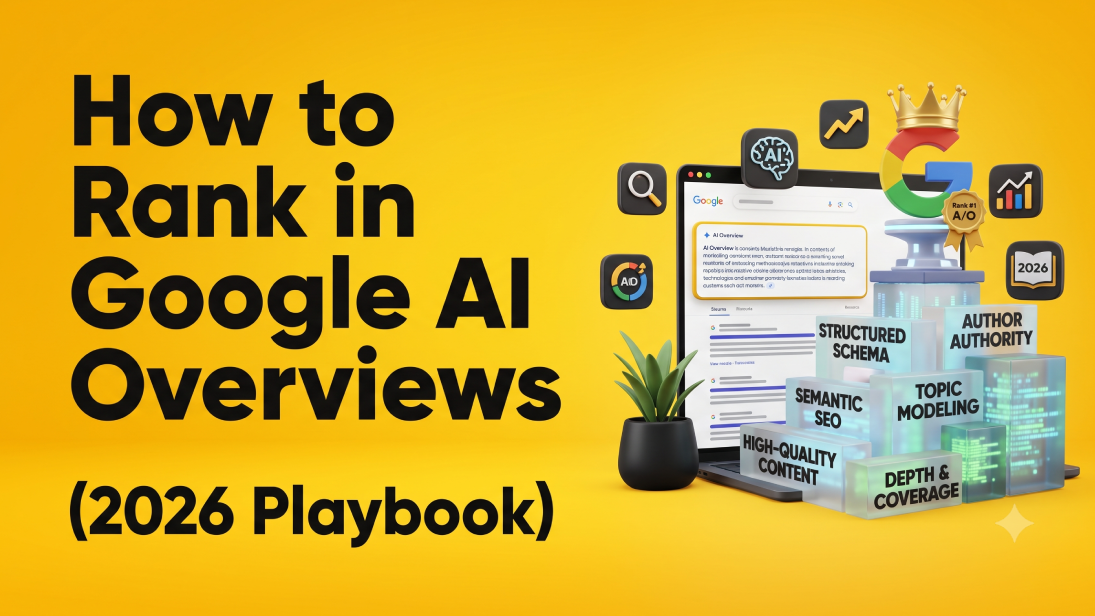
In this guide, I’ll explain exactly which techniques, technical optimizations, content structures, and authority signals are necessary in order to be cited by Google’s AI-driven answers.
Why? Because in 2026, ranking #1 is no longer the goal. Being cited by Google’s AI is.
What Are Google AI Overviews?
Google AI Overviews are AI-powered summaries shown on top of search results for many informational and commercial queries.
Rather than making users click through multiple pages, Google leverages its Gemini-based systems to:
- Analyze high-ranking content
- Extract relevant information
- Synthesize answers
- Present a summarized response
Imagine Google has read 20 websites and created a “best of” answer.
The AI Overview usually includes:
- Summaries
- Product recommendations
- Comparison information
- How-tos
- Statistics
- Insights by experts
- Sources
If your content is used as a source, then your brand will be included in the Google answer. This is why marketers are trying hard to figure out how to rank in AI Overview results.
Why AI Overviews Matter More Than Traditional Rankings
Many SEO specialists are obsessed with rankings. Google cares about answers. The difference between them.
Sometimes, a page that ranks #7 will be referenced in the AI Overview and not a page that ranks #2.
Why?
Because AI algorithms value:
- Informational quality
- Relevance to the topic
- Clarity of the answer
- Authority of the sources
- Contextual completeness of information
And not just rankings.
AI Overview: Visibility Benefits
Brand Authority
Once Google references your content, people will inherently trust your brand.
More SERP Real Estate
Your brand can appear in many different ways:
- AI Overview
- Organic result
- Featured snippet
- Knowledge panel
Higher Assisted Conversions
Users often research products multiple times before making a purchase.
Even when they don’t click on the link initially, exposure to the brand still impacts their purchasing decision.
Future-Proof SEO
AI search is not a fleeting trend. It is where the search engines are headed.
How Google Selects Content for AI Overviews
Google does not select content at random. AI systems analyze multiple criteria all at once.
Signals for Content Quality
Google considers content to be:
- Comprehensive coverage
- Clear explanations
- Updated information
- Accurate facts
- Expert insights
Google will ignore thin content. AI likes content that actually helps solve people’s problems.
Entity Recognition
Google’s Knowledge Graph plays a major role.
The search engine recognizes:
- Brands
- People
- Products
- Technologies
- Concepts
The stronger your entity relationships are, the better Google will understand your content.
Example:
Rather than constantly repeating:
“SEO helps to get better rankings.”
Try writing:
“Technical SEO enhances crawling, indexing efficiency, and Core Web Vitals.”
Entities help you build a stronger context.
Topical Authority
Google favors websites that show knowledge about complete topics more and more. Writing one article doesn’t turn you into an authority, but writing twenty interconnected articles can.
Examples are:
- AI SEO Guide
- AI Search Optimization
- Generative Engine Optimization
- AI Crawling
- AI Ranking Factors
Google understands the topical depth. This is exactly what any AI wants to see.
How to Rank in Google AI Overviews
Let’s get into the actionable strategies.
1. Write Content That Answers Questions Immediately
AI loves straightforward answers. Most sites hide them behind 500 words of fluff. Google hates this.
Bad Example
“What is AI Overview?”
6 paragraphs of storytelling later…
Gives you an answer.
Better Example:
What is Google AI Overview?
AI Overview for Google is an AI-generated search result that gives you an answer to your query using multiple information sources. And then go on expanding. This will improve AI extraction greatly.
2. Build Query-Based Content Architecture
A single page needs to answer multiple queries.
AI systems often extract information from sites with content architecture based on topic clusters.
Example:
For your main keyword
“How to rank in Google AI Overviews”
Have sections on
- What is AI Overview?
- Ranking Factors
- Content Structure
- Schema Markup
- EEAT
- Technical SEO
- Measurement
This creates semantic completeness.
3. Use Semantic SEO Instead of Keyword Stuffing
Keyword stuffing can be viewed as an SEO version of screaming. AI likes Google to have context.
Incorporate relevant entities:
For AI Overview Content
Some relevant semantic terms:
- Generative search
- Gemini
- Language models
- Search Generative Experience
- Retrieval systems
- Entity optimization
- Knowledge Graph
- Natural Language Processing
- Information Gain
Use of these keywords increases topical relevance.
4. Optimize for Information Gain
AI doesn’t care about reused content. It cares about unique value. This principle is referred to as Information Gain.
Consider these questions:
“What unique information does this article bring to the table compared to others?”
Examples:
- New frameworks
- Case studies
- Benchmarking data
- Results from testing
- Opinions of experts
- Own research
If your article is similar to everyone else’s, AI has no reason to cite you.
Strategies for Optimizing Content for Google AI Overviews
Let’s go deeper. Structure your answer using blocks of information. The following elements help the AI models grab content more easily.
- Definitions
- Process explanations
- Tables
- Comparisons
- Bullet points
- Statistics
No need to create walls of text. Who does that?
Create Content Using the Inverted Pyramid Method
This approach was developed by journalists decades ago.
Start with:
- Answer
- Context
- Supporting details
- Insights
This layout fits perfectly with AI extraction patterns.
Include Expert Commentary
Google’s systems are increasingly becoming more advanced at evaluating expertise.
Not:
“SEO is important”
But:
“Sites with great entity relationship, schema implementation, and topical authority tend to be featured in the AI-generated search results”
Specificity beats vague advice any day of the week.
Optimize for Retrieval, Not Just Rankings
One of the key changes that happened in AI-driven search is the way Google works; it retrieves specific snippets from different sources in order to produce an answer. In other words, your content should be easily retrievable, understandable, and cited by the AI systems.
For that reason, create sections that provide a clear and concise answer to the particular question without a lengthy introduction. AI likes to have a point in place without unnecessary details.
Use:
- Descriptive headings
- Lists
- Numbered steps
- Concise paragraphs
All those formatting techniques will make it easier for the AI systems to identify important data and increase the probability of selection of your content as the main one for AI Overviews.
Speaking about the content itself, remember to provide context along with just stating the fact. For example, if you want to inform your readers that Core Web Vitals affect rankings, show them the connection between fast loading time and the user experience.
Moreover, make sure there are no ambiguities in your content. Be precise and define all the terms, concepts, and entities that are discussed in your piece.
Optimize Website for AI Overviews Using E-E-A-T
Showcase your expertise by adding:
- Original screenshots
- Case studies
- Examples
- Tests
Only someone with first-hand experience can do that.
Strengthen Your Author Profile
Include:
- Author bio
- Author’s certification
- Industry expertise
- LinkedIn profile
- Author’s publications
Google wants to know the author behind the content.
Build Strong Citation Signals
References:
- Studies by industry
- Government data
- Scholarly research
- Official documents
Citations make your content valuable to AI algorithms.
Technical SEO Factors That Influence AI Overview Visibility
Many marketers focus only on content. Big mistake. Technical SEO remains critical.
Improve Crawlability
Google can’t use content it can’t access.
Audit:
- Robots.txt
- XML sitemaps
- Internal linking
- Redirect chains
Make crawling effortless.
Optimize Core Web Vitals
Key metrics:
Largest Contentful Paint (LCP)
Target:
Under 2.5 seconds
Interaction to Next Paint (INP)
Target:
Below 200 milliseconds
Cumulative Layout Shift (CLS)
Target:
Below 0.1
Fast sites send stronger quality signals.
Strengthen Internal Linking
Internal links help Google understand:
- Topic relationships
- Content hierarchy
- Entity connections
Create topic clusters rather than isolated pages. Think web, not island.
Schema Markup and AI Overview Rankings
A schema helps machines comprehend the content. AI loves structured information.
Implementation:
- Article Schema
- FAQ Schema
- Organization Schema
- Author Schema
- Product Schema
- HowTo Schema
- Review Schema
Schema provides machine-readable context. And AI thrives on context.
How to Improve Visibility in Google AI Overviews With Entity SEO
Entity SEO is becoming one of the most important ranking factors. Yet, most marketers overlook it. It’s their loss, not yours.
What Is an Entity?
An entity is:
- Person
- Company
- Product
- Location
- Concept
Entities are stored in the Knowledge Graph by Google. The clearer the connections between your entities for Google, the better.
Improve Brand Entity Signals
Consistently mention your brand through:
- Website
- Industry directories
- Media coverage
- Podcasts
- Contributions
Entity signals increase entity recognition.
Entity-Rich Language
Not “marketing software,” but rather:
“HubSpot CRM, Salesforce Marketing Cloud, and Marketo automation platforms.”
Specific entities create stronger semantic relationships.
Create AI-Friendly Content Formats
Certain content formats tend to outperform others.
Comparison Pages
Examples:
- HubSpot vs Salesforce
- SEO vs PPC
- GA4 vs Adobe Analytics
AI Overviews regularly refer to comparison pages.
Step-by-Step Guides
Content in instructional formats tends to do extremely well.
Example:
“How to Optimize Content for AI Overviews in 8 Steps”
Google loves how-to content.
Definition Content
- Simple.
- Clear.
- Accurate.
Definitions are one of the easiest content formats for AI extraction.
Data-Driven Research Pages
Original data is the best kind of data.
Create:
- Industry surveys
- Benchmarks
- Trend reports
- Performance studies
The more unique your data, the more citations you’ll get from both human and AI sources.
Measuring AI Overview Performance
Regular SEO metrics are no longer sufficient.
Measure:
Branded Search Growth
When AI picks up on your brand, your branded search volume increases.
Impression Growth
Watch Google Search Console. Impressions can increase before clicks.
Citation Tracking
Use:
- Semrush
- Ahrefs
- Authoritas
- ZipTie
- Profound
All of which are starting to incorporate AI visibility tracking.
Assisted Conversions
AI-affected users often convert later.
Measure:
- Multi-touch attribution
- Assisted conversions
- View-through attribution
Every win is not going to be a last-click conversion.
Common Mistakes That Prevent AI Overview Rankings
Writing Generic Content
If ChatGPT can create your blog post within 30 seconds, it’s not going to get any links from Google.
Ignoring Technical SEO
Great content on an unoptimized website hardly ever beats the competition.
Publishing Without Topical Authority
One article doesn’t build trust. Clusters do. No Structured Formatting. Messy content is harder for AI systems to process.
Weak EEAT Signals
- No author.
- No sources.
- No expertise.
- No visibility.
- No rankings.
The Future of AI Overview
Search is evolving from keyword matching to answer generation.
Google increasingly evaluates:
- Context
- Expertise
- Entity relationships
- Information gain
- User satisfaction
The websites that win won’t necessarily be the ones publishing the most content. They’ll be the ones publishing the most useful content.
The future belongs to brands that become trusted knowledge sources rather than keyword factories.
Final Thoughts
Learning how to rank in Google AI Overviews requires a shift in mindset. Stop optimizing solely for rankings. Start optimizing for extraction, citation, authority, and usefulness.
What is common about sites that appear in AI Overviews:
- Strong topical authority
- Entity-based SEO
- Technical excellence
- Proper content structure
- Expertise
- Gained knowledge and information
If your website is useful for Google to create better answers, Google will have reasons to include your content in its responses.
When Google’s AI starts citing your brand, you won’t be fighting for traffic anymore.
You will become a part of the answer.
Ready to Optimize Your Website for AI Search?
Xparro assists businesses in creating AI-based SEO strategies that take into account more than just ranking optimization. From entity optimization and technical SEO to topical authority strategy and AI Overview visibility, we assist companies in creating the presence needed to win the future of search.
Because the next battle for search traffic isn’t page one.
It’s becoming the source Google’s AI trusts.