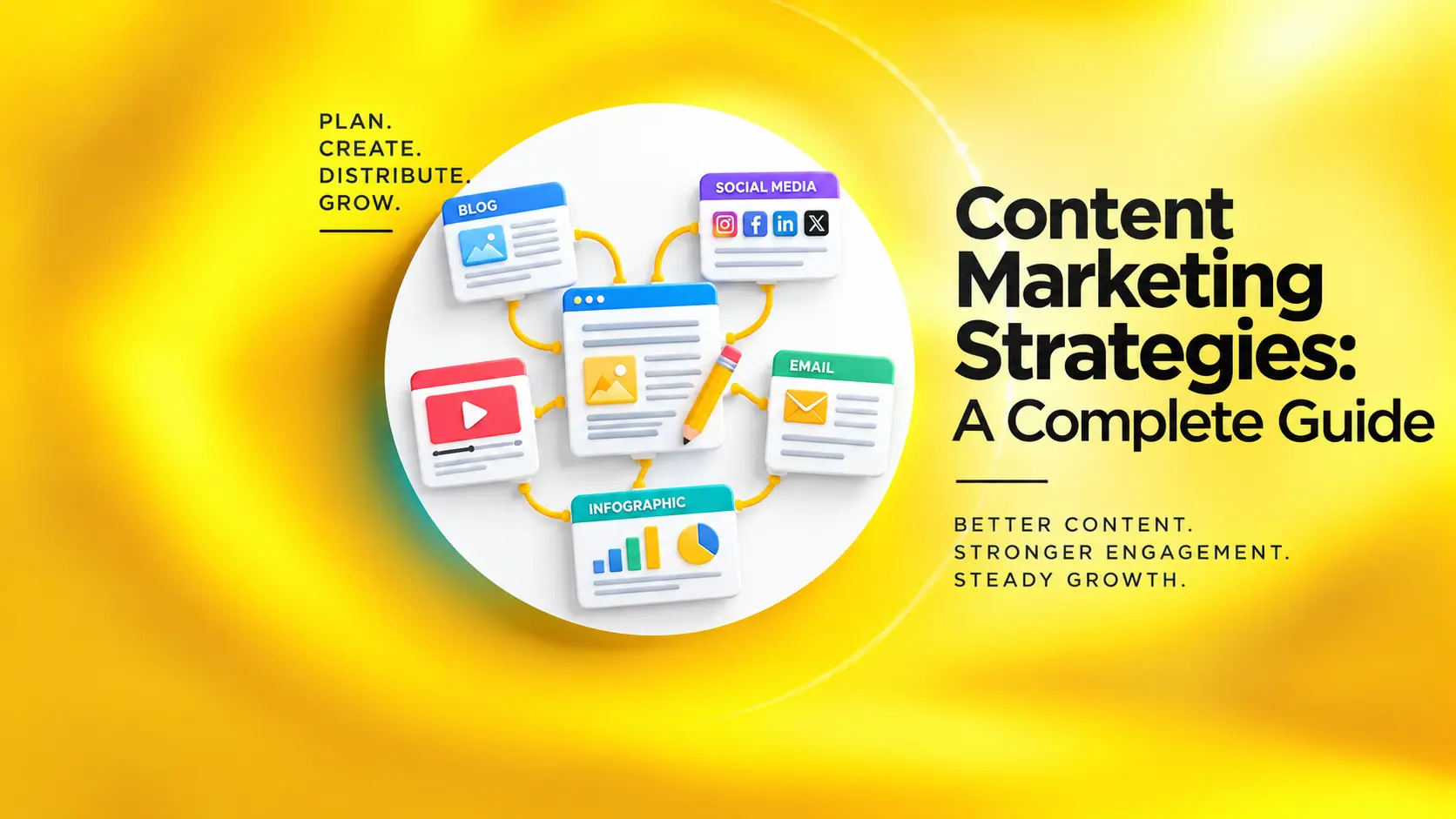
Publishing three blogs a week sounds productive. But if those blogs are not bringing the right people to your website, answering real buying questions or contributing to enquiries, what are they actually doing?
That is the problem many businesses run into with content marketing strategies. There is plenty being published, but very little of it is connected.
For UK businesses, the challenge is even bigger. People move between Google, social media, video and AI-powered search before they decide what to click, trust or buy. Ofcom reports that Google Search is used by 82% of UK adults, while UK adults spend an average of 4.5 hours online each day.
The answer is not simply to publish more. It is to build a content system that knows who it is speaking to, what they are looking for and where that content needs to take them next.
Key Takeaways
- How to connect content production to actual business goals instead of filling a monthly publishing calendar.
- How to build a blog content strategy around search intent, customer problems and topic relevance.
- How to create a content strategy for your website that supports people from their first search to the final enquiry.
- How to measure content using meaningful metrics such as qualified traffic, conversions and revenue influence.
Start With What the Business Needs
One of the easiest ways to derail a content strategy is to start with a keyword tool. You find a keyword with decent search volume, add it to the content calendar and hand it to a writer. Repeat. After six months, you have 30 new articles. Nobody can quite explain what they have achieved.
Start with the business objective instead.
If the company needs more leads, content should help capture searches from people who have a genuine problem to solve. If the priority is entering the UK market, the content needs to establish relevance for UK audiences and topics.
If sales teams keep answering the same questions, those questions probably belong on the website.
A simple framework helps:
| Business goal | What content should do | KPI to watch |
| Generate leads | Target high-intent searches | Organic leads |
| Build visibility | Establish topical relevance | Non-branded impressions |
| Support sales | Answer objections and concerns | Assisted conversions |
| Enter the UK market | Build UK-specific topical coverage | UK organic visibility |
| Increase enquiries | Reach decision-stage users | Conversion rate |
The important bit is the connection between the columns.
Traffic on its own does not pay the bills.
A page bringing 1,000 relevant visitors who actually enquire can be far more valuable than one attracting 10,000 visitors who leave after reading two paragraphs.
There is a measurement problem across the wider B2B content industry, too. Content Marketing Institute research found that 56% of B2B marketers struggle with attributing ROI to content, while the same proportion report difficulty tracking customer journeys.
So decide what success looks like before the content gets produced.
Build Your Blog Content Strategy Around Why People Search
Search volume tells you how many people may be searching for something. It does not tell you what they expect to find. That distinction can completely change an article.
Take the SEO industry as an example. Someone searching “what is SEO” is probably still learning. Someone searching “SEO strategy for small business” has moved further along and wants something practical.
Then you have “SEO agency London”. That person is not looking for another beginner’s definition of SEO. They are looking at providers. And “SEO agency pricing UK” suggests an even stronger commercial consideration. Same subject. Completely different intent.
Your blog content strategy should reflect that.
A useful intent structure
Informational intent covers definitions, guides, explanations and how-to content. Commercial investigation covers comparisons, pricing, reviews, alternatives and “best” searches. Transactional intent captures searches where the user is closer to taking action. Navigational intent relates to searches for a particular company, service or website.
Instead of producing 20 loosely related articles, build a connected topic cluster.
For example:
Pillar: SEO Services in the UK
Supporting content:
- What Is SEO?
- Local SEO for UK Businesses
- Technical SEO Checklist
- SEO Pricing in the UK
- SEO vs PPC
- How to Choose an SEO Agency
The supporting articles answer specific questions. Internal links then guide readers towards deeper information and relevant commercial pages.
Now your blog is doing more than collecting organic traffic. It is helping people move through the subject, and potentially towards a purchase.
Give Every Website Page a Job
A blog should not feel like a separate website living inside your website. Someone might discover your business through an educational article today, return through a case study next week and finally visit your service page when they are ready to enquire.
If those pages have no logical connection, the journey stops. Your content strategy for your website should give different content types different jobs.
Awareness content
This is where you meet people who know they have a problem but may not know what the solution looks like.
Examples include:
- Why Is My Website Traffic Falling?
- How Does Local SEO Work?
- What Is Generative SEO?
The next step does not need to be “Book a call”.
A related guide, checklist or deeper article might make more sense.
Consideration content
Now the reader is comparing options.
Think:
- SEO vs PPC for UK Businesses
- How Much Does SEO Cost in the UK?
- In-House SEO vs SEO Agency
This is where case studies, consultations and service pages can naturally enter the journey.
Decision content
Here, people want evidence.
They want to know what you actually do, how you work, what they receive and whether you can solve their particular problem.
That means service pages, case studies, industry pages, pricing information, FAQs and strong proof points all matter. And no, every page does not need the same giant “Contact Us” button.
The right CTA depends on what the visitor is trying to do.
Stop Treating Google as the Only Destination
Google remains hugely important in the UK. Ofcom reports that around 3 billion searches are made on Google each month in the UK. At the same time, search behaviour is changing as AI becomes part of the discovery process. Ofcom reported that around 30% of searches were showing AI Overviews, while ChatGPT recorded 1.8 billion UK visits between January and August 2025.
That does not mean SEO suddenly stops mattering. It means good content has to work harder.
An article should be useful enough to rank, clear enough to be understood, specific enough to be referenced and interesting enough to be shared. And once you have created something genuinely useful, do not let it sit on your blog and collect digital dust.
One research-led article could become:
- A LinkedIn carousel
- Several short social posts
- A newsletter
- A video script
- A downloadable checklist
- Sales enablement material
- A webinar topic
The research stays the same. The format changes.
That matters particularly for B2B brands. CMI’s 2025 research found that 89% of B2B marketers use organic social media to distribute content, while 84% use corporate blogs and 71% use email newsletters. Video was considered the most effective content format by 58% of respondents.
So instead of posting “We’ve published a new blog. Read it here.” Take the strongest idea from the article and build something useful around it. That is distribution with a purpose.
Put Your Own Expertise Into the Content
There is already enough generic content online. Another article explaining “what SEO is” is unlikely to make anyone remember your brand. The interesting material is often sitting inside your business.
Your sales team knows what prospects keep asking. Your customer service team knows where people get stuck. Your account managers know which objections come up repeatedly. Your campaign reports show what worked, and what absolutely did not.
Use that information.
Suppose your sales team keeps hearing “How long does SEO take to work?” There is your article. But don’t just write the usual answer about “SEO being a long-term strategy”.
Explain what affects the timeline. Talk about competition, technical problems, content quality, authority, starting visibility and the type of keywords being targeted. Explain what should actually be measured during the first three, six or twelve months.
Suddenly, the article has a point of view based on real experience. That is much harder for competitors to copy.
Measure Whether Content Is Actually Doing Its Job
Pageviews are nice. They are also very easy to celebrate when they mean very little. A stronger content measurement framework looks at four levels.
- Visibility: impressions, rankings, organic reach and branded search.
- Engagement: engaged sessions, returning visitors, scroll behaviour and interactions.
- Conversion: enquiries, downloads, demo requests and conversion rate.
- Revenue: assisted conversions, influenced pipeline and revenue connected to content.
Imagine an article receives 5,000 organic visits but generates no qualified enquiries. The obvious reaction might be, “We need more traffic.” Maybe not. The real issue could be the search intent.
Perhaps the article attracts students, early-stage researchers or people outside your target market. Perhaps there is no logical next step. Perhaps the article answers the question so completely that there is no reason to explore the business further.
Look at the whole journey.
A blog might generate only a handful of direct leads but introduce prospects who later return through a service page and convert. That is why content should be assessed at the cluster and journey level, not just URL by URL.
Let the Strategy Change When the Data Changes
A content strategy should not be carved in stone on 1 January. Markets move, competitors publish, search results change, customers start asking different questions, some of your best-performing articles will eventually lose momentum, too.
Review your content regularly and look for three things:
What is growing? Double down on topics already attracting relevant audiences.
What is missing? Find important questions your prospects are asking that your website does not answer.
What is declining? Refresh, consolidate or replace content that has lost relevance.
This is particularly important because only 29% of B2B marketers in CMI’s research rated their organisation’s content marketing strategy as extremely or very effective.
The lesson is not “publish more”. Quite often, it is the opposite. Make fewer, better decisions about what deserves to be published.
Final Thoughts
Good content marketing strategies are not built by filling a spreadsheet with blog titles. They start with the business, move through audience intent and end with measurable outcomes.
For UK businesses, that means creating content around the questions people actually ask, building logical connections between blogs and commercial pages, using genuine expertise instead of recycled information, and distributing useful ideas beyond the website.
Your blog content strategy should bring the right people in. Your content strategy for your website should give them somewhere useful to go next. And your measurement framework should tell you whether any of it is contributing to the business. That is the difference between having a content library and having a content engine.
If your website is already producing content but the results are not matching the effort, Xparro can help turn disconnected articles into a structured, SEO-led content strategy built around your audience, commercial goals and the UK market.
FAQs
What is a content marketing strategy?
A content marketing strategy is a plan for creating and distributing content that attracts the right audience and supports specific business goals, such as traffic, leads or sales.
How do I create a blog content strategy?
Start with your business goals and audience, then research search intent, map topics to the buyer journey and build connected content clusters. Track performance and update the plan as results change.
Why is a content strategy important for a website?
It gives each page a clear purpose, connects informational content with commercial pages and helps visitors move naturally from discovering a problem to considering and choosing a solution.